|

|
| MICRO-CREDENTIALS AND THE SKILLS AGENDA |
|
Twelve Fundamental Questions
In an era of uncertainty punctuated by massive job loss and unprecedented economic fallout from the COVID-19 global pandemic, micro-credentials represent a real opportunity to make lifelong learning accessible to all.
Contact Nord | Contact Nord addresses 12 fundamental questions about
micro-credentials, including:
- What are micro-credentials, who they’re designed for, who develops them and the standards that define their value.
- How micro-credentials help people acquire the skills they need — quickly — for the kinds of jobs that are in demand.
- Why micro-credentials matter and how they differ from long-form learning.
- The supports necessary for this type of learning, what people are looking for, what’s on offer, and the implications for the future of higher education.
- The challenges and issues associated with the growth and development of micro-credentials.
Read Micro-Credentials and the Skills Agenda – Twelve Fundamental Questions
|
 |
|

Host: Diana Laurillard, Professor, Learning with Digital Technologies, University College London (ULC) Institute of Education
Diana Laurillard is a professor of Learning with Digital Technologies at University College London (ULC), Institute of Education. She was previously Head of the e-Learning Strategy Unit at the Department for Education and Skills. She also served as Pro-Vice-Chancellor for learning technologies and teaching at The Open University, and on the Visiting Committee on IT at Harvard University. Her most recent book is Teaching as a Design Science, Routledge
|
|
New!
Learn How to Leverage the Six Learning Types to Help Students Succeed
Thursday, December 10, 2020 from 11:00 a.m. to 12:00 p.m. (ET)
Register Now!
How can we best use technology to help students learn well? To answer this question, it’s important to think first about learning and only then ask how can technology help to make this easier.
Join Professor Diana Laurillard, from the University College London (UCL) Institute of Education, who developed the Six Learning Types based on the Conversational Framework, to discuss these six basic types of learning that faculty and instructors can use in their online and blended courses.
During this FREE, one-hour interactive webinar, learn how to use the six types of learning in relation to different kinds of technology:
- Acquisition (read/watch/listen)
- Inquiry
- Discussion
- Practice
- Collaboration
- Production
|
|
|
|
|
|
A Free Contact North | Contact Nord Webinar
Motivating First-Year Computer Science Students Using Gamification
A Laurentian University Innovation
Tuesday, December 8, 2020 from 1:00 p.m. to 2:00 p.m. (ET)
Register Now
Learn how Dr. Aaron Langille uses gamification to engage and motivate his first-year computer programming students.
Host:

Dr. Aaron Langille, Master Lecturer, Department of Mathematics & Computer Science, Engineering and Architecture at Laurentian University
View Contact North | Contact Nord’s full list of Upcoming Pockets of Innovation Showcase Webinars
|
|
|
 |
|
Back by Popular Demand!
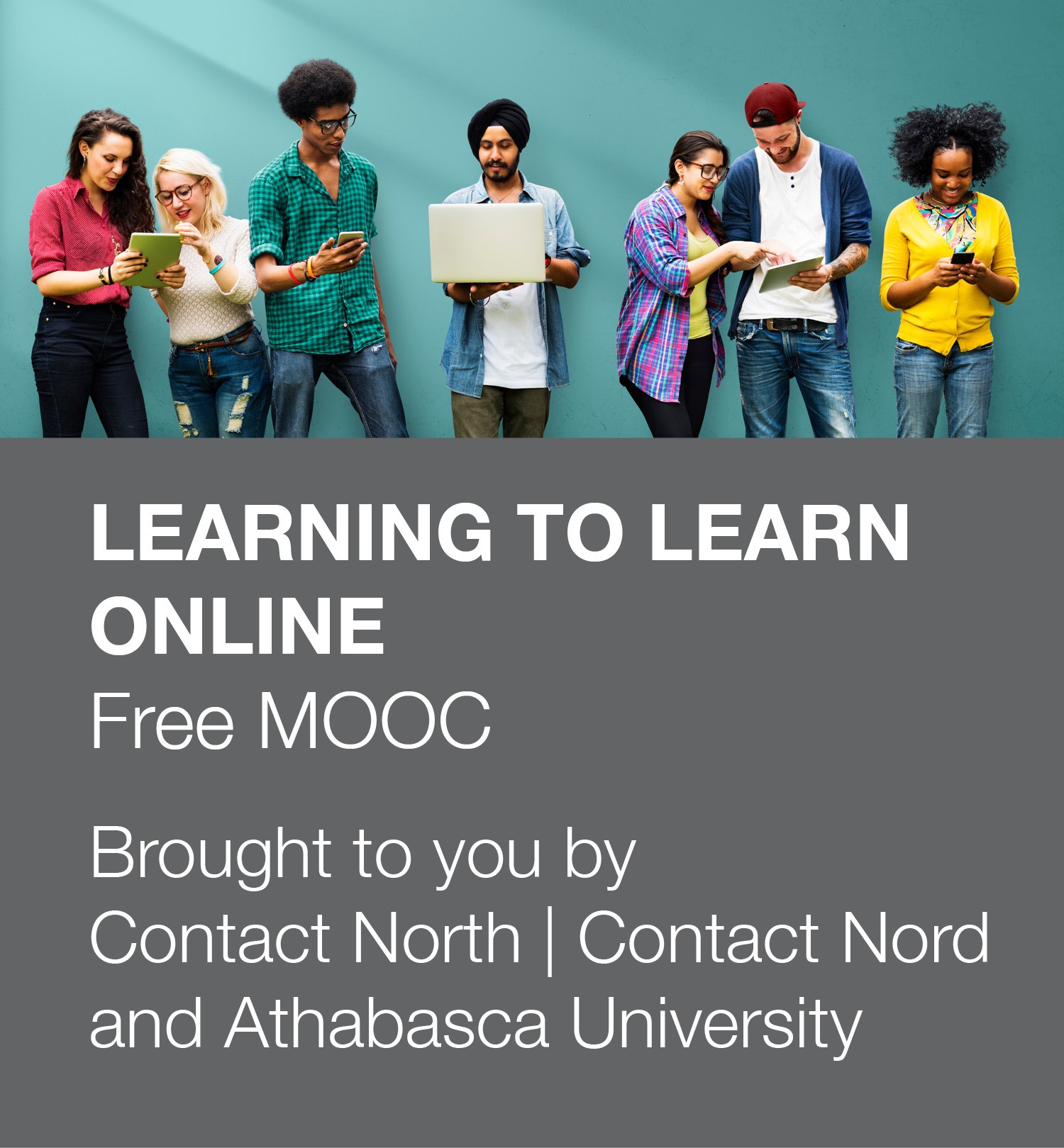
A Free Massive Open Online Course (MOOC) to Help Students Successfully Learn Online
Monday, January 18 to Sunday, February 21, 2021
Contact North | Contact Nord and Athabasca University are offering a massive open online course, Learning to Learn Online (LTLO), to introduce concepts and practices important to successfully learning online. Students can start the course anytime after January 18, 2021, but must complete it no later than February 21, 2021.
LTLO is intended for students who are learning online for the first time or want to improve their approach to online learning and is also open to teachers or educational professionals who want to support their students in learning online.
More information and Registration
|
|
|
 |
|
Today!
Spots Available!
How to Use the HyFlex Method to Teach Online and In-Person at the Same Time
Wednesday, December 2, 2020
1:00 p.m. to 2:00 p.m. (ET)
Register Now!
Join Dr. Brian Beatty, Associate Professor of Instructional Technologies at San Francisco State University for this FREE, one-hour interactive webinar to:
- Learn how to use a flexible course framework that offers a combination of online, synchronous, and face-to-face options (hybrid) in a course where students are able to choose when and how they attend (flexible).
- Develop successful strategies to engage online and in-class students in a single class session.
- Understand how HyFlex options prepare an institution (or program) for any other situation requiring an immediate shift to fully online.
- Learn how assessments for and of learning can work when students are studying the same course in class and online.
View the full list of free upcoming Contact North | Contact Nord webinars
|
|
|
|


|
|
Last Chance to Register!
Virtual Edition of
The Learning & Training Conference 2020
Tuesday, December 8 – Wednesday, December 9, 2020
The 2020s is a decade of learning innovations enabled by technologies.
Over two days in December, join us virtually to focus on the skills needed by individuals, corporations, organizations and communities for tomorrow’s workplace, the ways technology can enable the development of these skills, and how learning is being organized and delivered through new approaches, partnerships and credentials.
- Explore the emerging pedagogy that embraces emerging technology and highly skilled faculty, instructors, and teachers to achieve new levels of student engagement and outcomes.
- Learn from examples of innovative organizations – schools, colleges, universities, corporations, social enterprises – that are imagining and delivering new approaches to learning.
- Look at new approaches to skills recognition and support for learners and the ways in which learning on demand is being imagined and delivered.
- Explore new and emerging technologies to support the delivery of quality learning experiences.
The Learning & Training Conference 2020, formerly the ONLINE LEARNING conference series, is hosted by Contact North | Contact Nord.
|
|
|
 |
|
Live Session!
Ask Ron Anything About Teaching with Zoom
Wednesday December 16, 2020 from 1:00 p.m. to 2:00 p.m. (ET)
Here’s your opportunity to ask those nagging questions you have about teaching effectively with Zoom. Contact North | Contact Nord’s Research Associate and leader of our successful Zoom webinar series, Dr. Ron Owston, fields live questions on any aspect of teaching with Zoom.
Register early and submit your questions for Dr. Owston to ensure they are answered.
|
|
|
 |
|
Read Dr. Tony Bates’ Blog Post
In this blog post, Dr. Bates reviews the results of EdTech company Top Hat’s survey that examines the experience of students in the fall semester and the implications for online learning.
Read Contact North I Contact Nord Research Associate Dr. Tony Bates’ blog post:
Students’ responses to remote learning in the fall: Top Hat survey
|
|
|
 |
|
New!
Contact North | Contact Nord’s Directory of 75+ Ontario EdTech Companies
Ontario is a major hub in the fast-growing EdTech market, with more than 75 established and recent start-ups in educational technology and corporate training.
With this searchable directory, Contact North | Contact Nord provides colleges, universities, training providers and investors from around the world with information on how to find the latest products and services from Ontario-based EdTech companies. Their products and services often lead to improved learning experiences.
Explore the directory
|
|
|
 |
|
Must-Read Books on Online Learning
Must-Read Books on Online Learning features books and articles of interest to those involved in the expansion and improvement of online learning.
Lowenthal, P. R., & Dennen, V. P. (Eds.). (2019). Social presence and identity in online learning. New York, NY: Routledge.
Originally published as a collection of papers in the journal Distance Education, this is another set of materials which will help you think about how we move past a “banking” notion of online learning where students receive “chunks” of information, are tested on it, and put the test in the bank. The book pushes us to consider the idea of a community of inquiry and constructivists’ understanding of learning processes and the need for instructors and students to engage and experience a real sense of presence. Gert Biesta, the educational philosopher, reminds us that teaching and learning are intensely personal experiences and require presence. Some theory, a lot of practical examples and some great ideas.
Browse all Must-Read Books
|
|
|
|
|
 |
|