
When institutions say they accomplished online learning during the COVID-19 pandemic, what was implemented at scale was more often emergency remote teaching. It enabled access and continuity, but it also produced widespread Zoom fatigue. This is not high-quality online pedagogy. Online learning is too often treated as content delivery rather than an active, social, inquiry-based practice. That leads to predictable design failures: digitizing lectures instead of redesigning learning, under-designing interaction and feedback, and trying to replicate traditional teaching models rather than designing for participation, practice, and performance.
The result is underwhelming online learning, with recorded content as a substitute for teaching, minimal facilitation, limited feedback loops, and discussion boards filled with dead posts.
We think the “impossible” sits across three dimensions, shaped by entrenched assumptions about learning: pedagogical (misunderstanding learning as delivery rather than active, social, inquiry-based practice), institutional (systems, policies, governance, and workload models that reinforce traditional teaching structures), and cultural (reluctance to let go of models that define traditional academic identity). Teachers commonly presume that labs, practicums, fieldwork, collaboration, and supervision must be face-to-face. In our book, we show that designing online education is an adaptive challenge, and it starts with reframing what the learning is meant to accomplish.
In a genuinely well-designed online system, the academic stops trying to do the whole job alone. The solo lecturer model may make sense in a face-to-face world, but online it is a recipe for constrained design and staff burnout. What works is when academics understand themselves as part of a design team and take shared responsibility for the learning experience. That means partnering with learning designers and academic skill developers “third space” colleagues who translate good pedagogy into coherent online structure, working with technologists to make interaction, collaboration, and accessibility actually possible, and using data and AI tools selectively to strengthen feedback, pacing, and student support rather than to automate teaching.
In many respects, this lifts the academic role and frees academics to be the disciplinary experts they are, to share their intellectual insight, exercise judgement about what counts as evidence and quality, and stay close to the most human (and most rewarding) parts of the experience, including guiding inquiry, giving substantive feedback, and building a sense of connection and belonging.
The biggest design mistake we keep seeing is that colleges and universities treat going online as a translation exercise: record the lecture, upload the slides, add a discussion board, and hope the rest takes care of itself. The trouble is that this reproduces the weakest parts of the classroom in a digital space, so learners end up with content-heavy subjects, poor interaction, and superficial feedback. In our view, the alternative is intentional design. Start from what you actually want learners to be able to do, build in activity, practice, and iteration, and make feedback and teaching presence part of the infrastructure rather than an afterthought. When online learning works, it is because it has been designed by a team, with a clear purpose and shared values, and with relationships and belonging taken seriously. In short, good online learning aims to transform learning rather than replicate the classroom.
If we had our way, in ten years higher education would be a connected learning ecosystem. The campus would still matter, but it would sit alongside well-designed online, blended, virtual, and on-campus experiences, intentionally woven together so that learners can move in and out of study across a lifetime, accumulating learning outcomes, receiving credible recognition for prior learning, and staying connected to the institution beyond a single degree. In that future, the college or university functions more like a networked platform for learning and civic purpose: it connects learners, academics, industry, and community partners around authentic problems, with equity, care, and social responsibility at the centre, and a clear commitment to scholarly integrity.
Organizationally, this shift requires universities to stop treating online learning as an optional add-on and start building it as core infrastructure, with program-level curriculum and assessment design, properly resourced co-design teams, and governance that supports iteration rather than punishing experimentation.
It also means redesigning academic roles and workload to make team-based design possible, investing in digital and AI capability for staff and students, and putting ethical guardrails around analytics and AI so that technology strengthens human judgement and relationships rather than replacing them.
Perhaps most importantly, it requires a cultural reset in what colleges and universities reward: teaching needs to be recognised as intellectual leadership and valued alongside research, because the credibility of the future college or university will be built on the quality of learning, the integrity of assessment, the strength of the relationships it sustains, and its contribution to the public good through the graduates it forms.
 Rachel Fitzgerald
 Henk Huijser
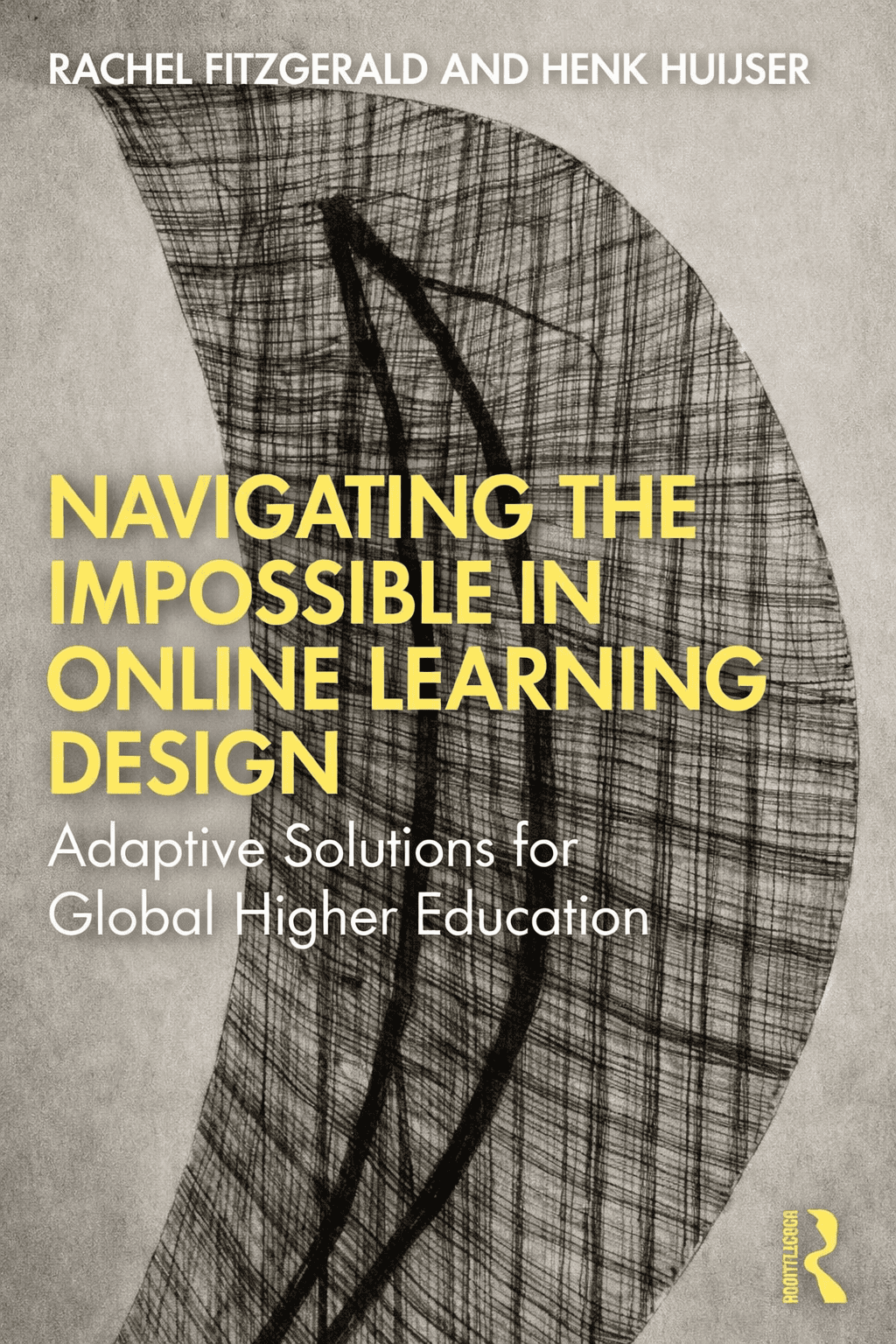
Navigating the Impossible in Online Learning Design examines one of the central dilemmas facing contemporary higher education: how institutions can meaningfully design online learning experiences in an environment characterized by complexity, competing expectations, and rapidly evolving technological possibilities. Edited by Rachel Fitzgerald and Henk Huijser, the book brings together case studies and conceptual reflections that explore how educators and instructional designers attempt to solve problems that often appear, at first glance, almost impossible. The book situates itself firmly within the post-pandemic context in which online and blended learning are structural features of higher education rather than temporary emergency measures.
The editors frame the central challenge clearly: designing high-quality online learning environments is not simply a matter of transferring existing course materials into digital platforms. Effective online learning requires deliberate pedagogical design, attention to learner needs, and thoughtful integration of technology with assessment and engagement strategies. Research consistently shows that simply uploading lecture content into a learning management system does not produce effective learning; rather, online courses require clear organization, interactive elements, and alignment between learning outcomes, activities, and assessment.
The strength of the book lies in its insistence that instructional design must operate in real institutional contexts. Many chapters explore the tensions between pedagogical ideals and institutional realities: limited resources, time pressures on faculty and instructors, uneven digital literacy among learners, and organizational resistance to change. These constraints often lead educators to feel that meaningful innovation in online learning is unattainable. The contributors challenge this pessimism by presenting examples of adaptive design strategies that respond creatively to these constraints rather than ignoring them. In this respect, the book’s central metaphor – “navigating the impossible” – captures the sense that effective design work often occurs within systems that were never built to support it.
Several themes recur throughout the book. First is the recognition that online learning design is inherently collaborative. Instructional designers, academic staff, technologists, and learners themselves all play a role in shaping the learning environment. The book provides useful examples of cross-functional design teams working together to re-think course structures, assessment approaches, and learner support mechanisms. This emphasis on collaboration reflects a broader shift in higher education toward distributed expertise in course development rather than the traditional model of the lone academic designing a course independently.
A second major theme is adaptability. The editors highlight the need for learning designs that can respond to diverse learner circumstances and institutional contexts. Online learners often include working adults with significant time constraints and varying levels of prior knowledge. Effective course design must therefore account for flexibility in pacing, accessibility of materials, and multiple forms of engagement. The case studies demonstrate how design approaches can be iteratively adjusted in response to learner feedback and changing technological conditions.
A third theme concerns assessment and academic integrity. As institutions increasingly adopt digital delivery, questions about authentic assessment and meaningful evaluation become more pressing. Several chapters examine alternatives to traditional exams, including project-based assessment, reflective portfolios, and collaborative tasks. These approaches attempt to align assessment more closely with real-world skills and competencies while also reducing reliance on high-stakes testing environments that are difficult to secure online.
One of the most valuable contributions of the book is its emphasis on reflective practice. Rather than presenting universal models of instructional design, the authors emphasize context-specific experimentation. The case studies illustrate how design solutions emerge through cycles of implementation, evaluation, and revision. In doing so, the book avoids the overly prescriptive tone that characterizes many instructional design manuals. Instead, it positions design as an ongoing inquiry process – one that requires educators to continually test assumptions about teaching and learning in digital environments.
The book is also commendable for its global orientation. Contributors draw on experiences from institutions in different countries and educational systems, highlighting the diversity of contexts in which online learning must function. This international perspective reinforces the editors’ argument that there is no single “best practice” model for online learning design. Instead, successful approaches must be responsive to local conditions, cultural expectations, and institutional priorities.
Despite these strengths, the book is not without limitations. Readers seeking a systematic framework or comprehensive theory of online learning design may find the case-study structure somewhat fragmented. While the diversity of examples is valuable, the book occasionally lacks a strong integrative synthesis that draws broader theoretical conclusions from the individual chapters. Additionally, some chapters assume a level of familiarity with instructional design terminology that may challenge readers outside the field.
Nevertheless, these shortcomings do not diminish the overall value of the book. For instructional designers, academic developers, and faculty and instructors engaged in digital transformation projects, the book offers a rich set of practical insights and reflective examples. Its emphasis on adaptive problem-solving is particularly relevant at a time when colleges and universities are still negotiating the long-term implications of large-scale digital learning adoption.
In summary, Navigating the Impossible in Online Learning Design makes an important contribution to contemporary discussions about digital pedagogy. By highlighting the messy realities of institutional life and the creative strategies educators use to address them, the book provides a realistic and encouraging portrait of instructional design work in higher education. It reminds readers that designing effective online learning is rarely straightforward – but with thoughtful collaboration, iterative experimentation, and a willingness to challenge established practices, even the “impossible” problems of digital education can begin to yield workable solutions.
We use cookies on this site to enhance your user experience
By clicking "Accept" you agree to practices outlined in our Privacy Policy