
The primary threat, which has been the same for the last few decades, is chronic underfunding. In the 1990s, tuition costs for a university degree were more than 80% covered by the state; by 2025 that percentage had dropped to an average of 41%.
The funding that has been provided comes with many strings and a repositioning of higher education as a private good, narrowing the university’s purpose to serve the labour market and industry, to the detriment of the public good and society as a whole.
Recently, universities in traditionally regarded liberal democracies have found themselves increasingly under siege by authoritarian governments, chiefly in the United States and other illiberal regimes, but these alarming trends are also migrating north to Canada, most noteworthy to Alberta and Ontario. Universities are global targets for heavy-handed governments seeking to control their citizens as well as the official doctrine, thus limiting dissent and the civic imagination. They achieve such ends by a number of levers including defunding, intervening and weakening institutional autonomy, academic freedom and collegial governance practices for short-term partisan and ideological goals.
We mostly reject the premise that universities are distant from everyday concerns. Increasingly, universities are responding to community needs and societal goals. In fact, there is little in our everyday comings and goings that hasn’t been touched by the university in one way or another.
As Cole, a contributor to the collection points out: “Consider just a handful of discoveries that have been produced at universities over the past 60 years or so that have altered our lives. The development of computer technology grows exponentially every several years, with quantum computing about to revolutionize our current capabilities; the algorithm for Google searches; the cure for childhood leukemia; the Global Positioning System; DNA fingerprinting; developments in artificial intelligence; fetal monitoring; scientific cattle breeding and food production; CRISPR technology, which modifies genetic code; the development of antibiotics; the human genome project; stem cell research; and ways to use the autoimmune system to treat various forms of cancer,” just to mention a few.
When high tuition saddles students with a huge mortgage on their education, it narrows their choices and makes teaching and learning instrumental, rather than focused on curiosity, self and social development, and life fulfilment and actualization.
Internally, underfunding turns university leaders into managers, compliant and complicit: They must balance budgets by cutting academic programs, too often in the arts, humanities and social sciences. In turn, this makes academics defensive and protective of their own turf rather than able to champion the entire academic agenda and the full array of disciplines that enhance the public good and human understanding and flourishing.
It also bears acknowledging that the cynical questioning of universities and their value has primarily come as a result of concerted efforts by right-wing think tanks, politicians, techno-feudalist bros, mega moguls and corporate lobbyists in an effort to undermine trust in public and publicly funded institutions.
There is nothing like the concept of a university in all of society. Universities are, and have been, some of the most successful institutions ever created. The university is charged with seeking truth, making discoveries and passing on knowledge and wisdom. In a democracy, the university also has as its unique purpose that of asking difficult questions of governments, of other power structures and of society itself. Its role includes ensuring that public policy is informed by the best available evidence as well as helping to foster critical and creative citizens whose formation prepares them for a lifetime of meaningful employment, community engagement and democratic participation.
Perhaps it is true that we who work in the academy need to be more deliberative and aspirational about our unique mission because if populations are inadequately educated, they are ripe for abuse at the hands of political and capitalist tyrants.
The university, rather than being an ivory tower is, in reality, a societal lighthouse. It serves as a beacon and a guide, illuminating dangers and providing safe passage through uncharted and turbulent waters.
Providing funding at least to 1990s levels, while fighting the urge to increase control and micro-management should be a social priority. A so-called “Canada Strong” strategic plan needs more than just pipelines and high-speed rail. We need a bold nationwide reinvestment.
Of course, tightly monitor finances and spending through appropriate auditing procedures, but always while respecting collegial governance, academic freedom and institutional autonomy in order to allow the university to fulfil its mission and function to society.
As ministers of advanced education, we would provide a vision for pre-K to 16 funding for post-secondary education of all kinds for up to four years after grade 12 to prepare students and society for our current world and, more importantly, for the one on the horizon with all the ensuing changes that haven’t even been imagined yet.
Romard (2026) recently noted in a report for the Canadian Centre for Policy Alternatives, “Universities and colleges lead the way on driving economic growth: Universities and colleges’ economic output was worth $61 billion in 2025, which was 2.1 per cent of Canada’s total GDP — just $5 billion behind residential building construction, much more than all oil sands extraction ($49 billion) and almost twice as much as mining or transportation manufacturing (at $33 billion each).”
Our conclusion to Knowledge Under Siege ends with this slightly updated Greek proverb: “A society grows great when old folks plant trees in whose shade they shall never sit.” A properly functioning, reimagined and fully aspirational university is, then, just that: an investment in the world’s collective future.


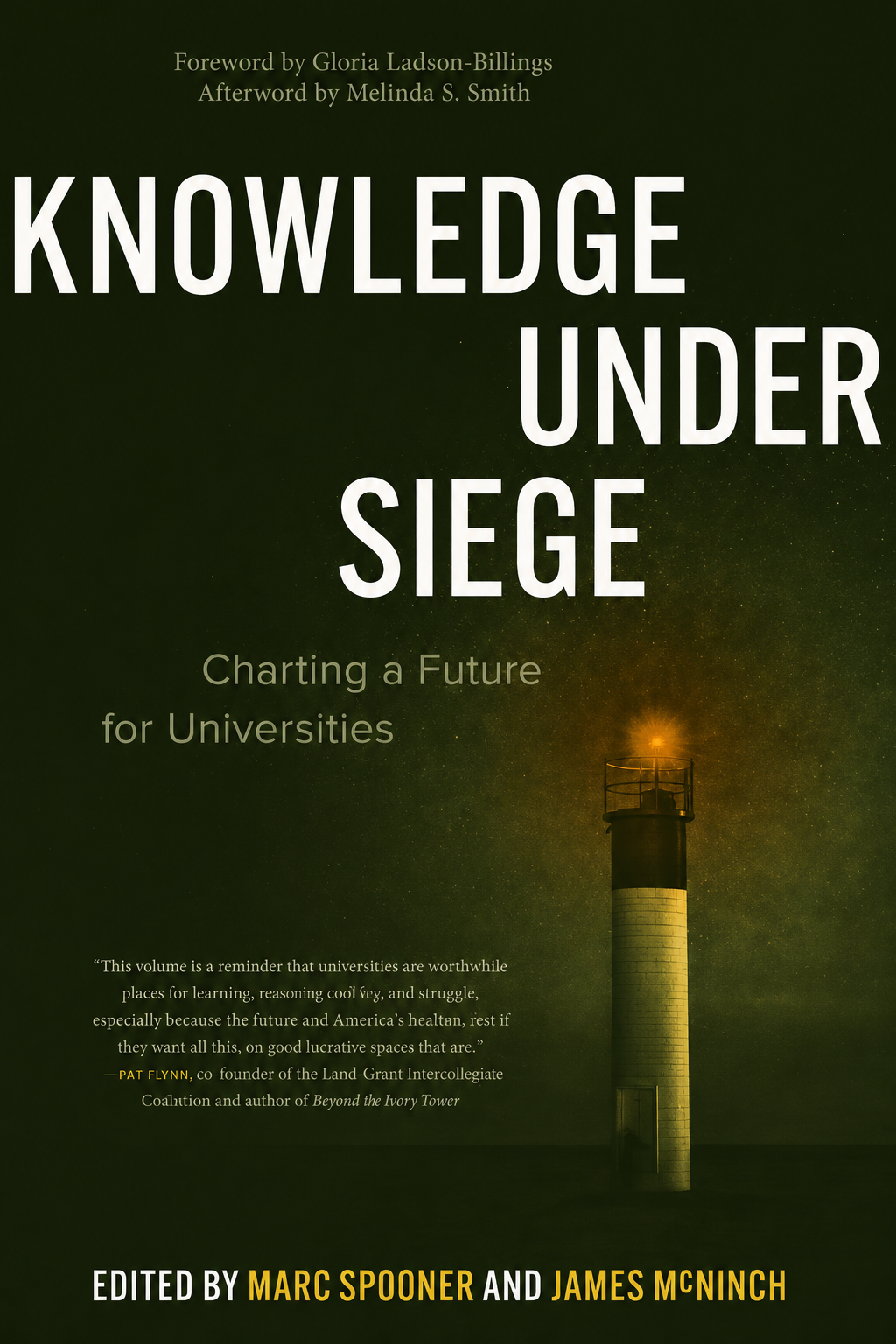
This is a provocative and timely collection that examines one of the defining questions of our era: What are universities for when trust in institutions is declining, public funding is tightening and political pressures are intensifying? Bringing together an impressive range of international scholars, the book frames higher education as both a contested institution and an indispensable democratic resource.
The core tension running through the volume is between the university as public good and the university as market actor. Many contributors argue that decades of managerialism, performance metrics, branding culture and return-on-investment thinking have narrowed universities’ mission. Institutions designed for inquiry, critique and civic development are increasingly asked to justify themselves through employability data, rankings and commercial outcomes.
A second major tension is between institutional autonomy and political control. The book highlights threats such as government interference, academic gag orders, attacks on tenure and hostility toward equity initiatives. Universities are portrayed as early targets when democratic cultures weaken because they remain spaces where inconvenient truths can still be examined.
Yet the book is not simply pessimistic. Its more positive scenarios imagine universities becoming genuinely inclusive engines of social mobility, places where Indigenous knowledge systems are respected and democratic citizenship is renewed, and where teaching is reoriented toward truth-seeking, critical thought and public problem-solving. Chapters by scholars such as Linda Tuhiwai Smith and others suggest futures in which universities broaden whose knowledge counts and whom they serve.
The darker scenarios are equally clear: universities hollowed out by austerity, governed by metrics, fearful of controversy, detached from communities, and captured by partisan or corporate interests. In that future, they survive as brands but lose their intellectual soul.
What makes Knowledge Under Siege compelling is that it refuses nostalgia. The editors do not ask for a return to some golden age. Instead, they call for reinvention: universities that are self-critical, socially accountable and courageous enough to defend free inquiry while confronting their own exclusions. For leaders in higher education, this is less a lament than a strategic warning and a blueprint for renewal.
There is nothing like the concept of a university in all of society. Universities are, and have been, some of the most successful institutions ever created. The university is charged with seeking truth, making discoveries and passing on knowledge and wisdom. In a democracy, the university also has as its unique purpose that of asking difficult questions of governments, of other power structures and of society itself. Its role includes ensuring that public policy is informed by the best available evidence as well as helping to foster critical and creative citizens whose formation prepares them for a lifetime of meaningful employment, community engagement and democratic participation.
Perhaps it is true that we who work in the academy need to be more deliberative and aspirational about our unique mission because if populations are inadequately educated, they are ripe for abuse at the hands of political and capitalist tyrants.
The university, rather than being an ivory tower is, in reality, a societal lighthouse. It serves as a beacon and a guide, illuminating dangers and providing safe passage through uncharted and turbulent waters.
Providing funding at least to 1990s levels, while fighting the urge to increase control and micro-management should be a social priority. A so-called “Canada Strong” strategic plan needs more than just pipelines and high-speed rail. We need a bold nationwide reinvestment.
Of course, tightly monitor finances and spending through appropriate auditing procedures, but always while respecting collegial governance, academic freedom and institutional autonomy in order to allow the university to fulfil its mission and function to society.
As ministers of advanced education, we would provide a vision for pre-K to 16 funding for post-secondary education of all kinds for up to four years after grade 12 to prepare students and society for our current world and, more importantly, for the one on the horizon with all the ensuing changes that haven’t even been imagined yet.
Romard (2026) recently noted in a report for the Canadian Centre for Policy Alternatives, “Universities and colleges lead the way on driving economic growth: Universities and colleges’ economic output was worth $61 billion in 2025, which was 2.1 per cent of Canada’s total GDP — just $5 billion behind residential building construction, much more than all oil sands extraction ($49 billion) and almost twice as much as mining or transportation manufacturing (at $33 billion each).”
Our conclusion to Knowledge Under Siege ends with this slightly updated Greek proverb: “A society grows great when old folks plant trees in whose shade they shall never sit.” A properly functioning, reimagined and fully aspirational university is, then, just that: an investment in the world’s collective future.
We use cookies on this site to enhance your user experience
By clicking "Accept" you agree to practices outlined in our Privacy Policy