This post is part of Sci-Fi Scenarios, the foresight series on teachonline.ca in which leaders in education and technology respond to five “sci-fi–sounding but plausible” AI futures.
We asked contributors to review five AI-driven scenarios for higher education (2025–2035), pick the one they find most compelling and explain why, and then add one future scenario of their own.
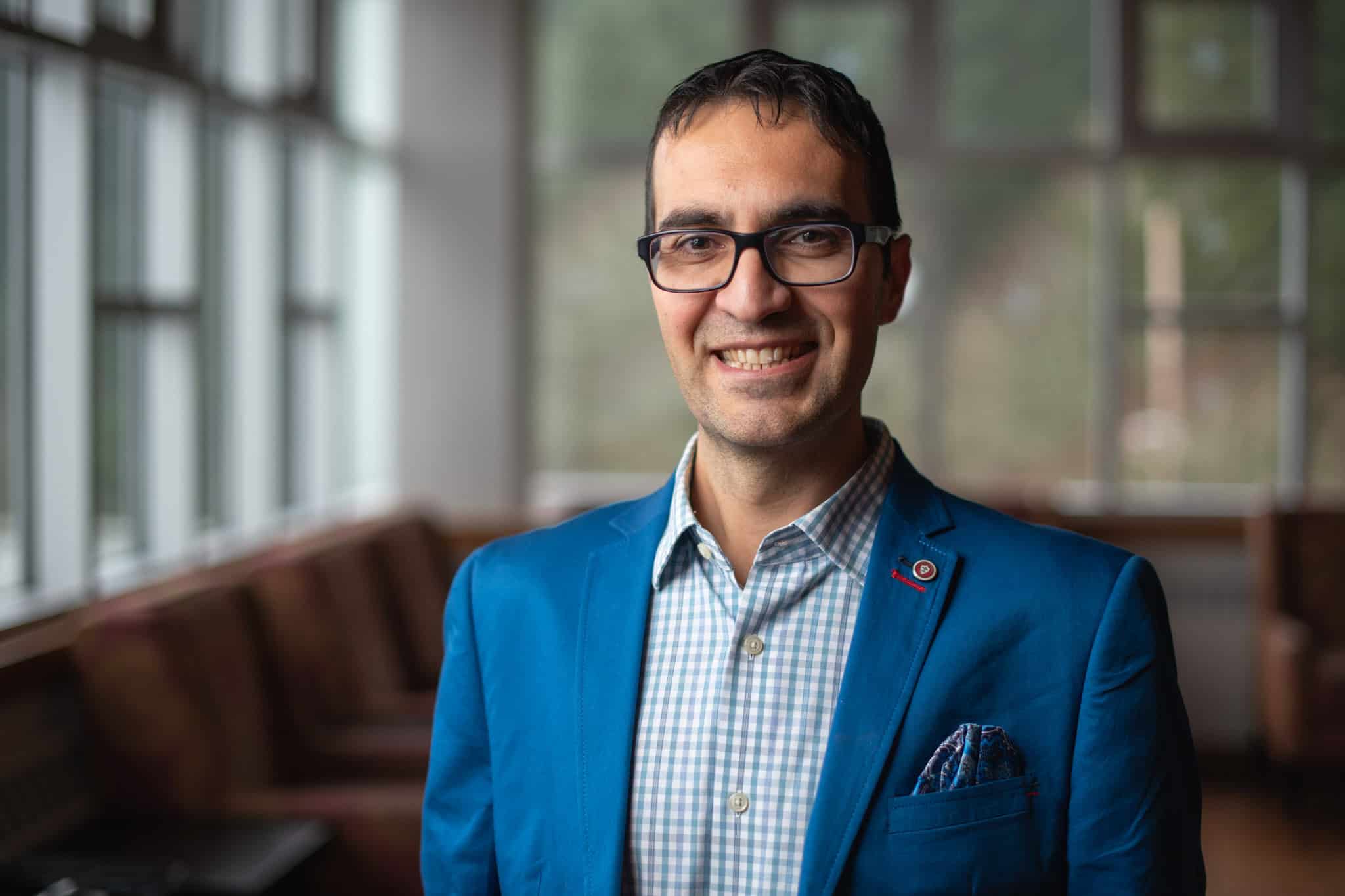
Below is the response from Dr. George Veletsianos, one of the leaders we invited to comment.
The Scenario Dr. George Veletsianos Selected From our Five Futures Is “Cognitive Twins for Every Learner”
Imagine an AI companion that knows you better than any teacher ever could. This is the promise of Contact North’s “cognitive twins” scenario: a personalized and adaptive digital learning partner that learns alongside students from their first day of university. It remembers every goal they’ve set, every piece of feedback they’ve received and every learning strategy that has helped them succeed. It is a personal coach, a mentor and an advisor all rolled into one seamless system designed to build their agency and self-regulation. The twin would be seamlessly integrated across various courses and platforms and would be based on secure, student-owned data with opt-in sharing controls. This scenario builds on disciplinary knowledge and interdisciplinary scholarship to deliver an all-encompassing and all-knowing tutor to support learning that many have been anticipating and working toward as early as Sidney Pressey’s Automatic Teacher in the early 1920s.
Why this scenario demands attention
This vision presents an almost irresistible promise, and it is important to unpack it. First, while an aspiration for more than 100 years, the concept of a supportive, personalized, and adaptive tutor that has a “long-term memory” now seems imminent. Second, the scenario focuses on a lifelong companion rather than one integrated in a single course or one that serves a particular instructional function. It is expansive and integrates many aspects of a student’s academic and personal development, making its influence deep and pervasive. Finally, because it is so personal and persistent, the Cognitive Twin has the potential for both profound good and significant harm. In other words, this is a high-stakes scenario that requires our attention.
Benefits and risks
The benefits have been described elsewhere: tireless support, instant access and freeing up teachers for more human-centric tasks. Yet the twin’s core design introduces profound risks. The very features that make it powerful — especially its persistent memory — risk producing unintended consequences. The twin’s persistent and long-term memory creates a fundamental power imbalance between the learner, the twin and the companies that create these technologies. Living under the gaze of a perfect digital memory raises questions about student well-being and psychological impacts: What is the personal toll of having a digital companion that never forgets your lowest grade or your most confused moment?
The New Future Scenario George Veletsianos Envisions Himself Is The Ephemeral Tutor
One way to redress this imbalance is to give learners the “right to delete,” a concept similar to the “right to be forgotten.” The Right to be Forgotten, established in European Union law (GDPR), gives individuals the right to have outdated or irrelevant personal information removed from search engine results and databases. Just as the Right to be Forgotten allows someone to move on from a past mistake that appears in a Google search, the Right to Delete in the cognitive twin context allows a student to academically move on from a failed exam or a difficult semester, ensuring their past does not influence or, worse still, permanently define their future. This gives rise to the Ephemeral Tutor: a tutor built on the principle that learning data should be temporary unless the learner decides otherwise.
What the right to delete enables
The Right to Delete isn’t just about privacy settings or opting out. It is the simple, powerful and absolute ability for any student to tell their cognitive twin:
- “Forget our conversation from yesterday.”
- “Delete my performance data from my first semester.”
- “Erase the feedback on that project I’d rather forget.”
- “Forget everything that you know about me.”
Permanent erasure and granular control
Crucially, this must be a right to permanent erasure, not just archival. A true Right to Delete means the data is gone for good, fully severing the link between the learner and their past performance. The combination of permanent erasure and granular control (e.g., the choice to erase a single interaction or one’s entire history) is what makes it flexible to learners’ needs and agency.
Why it matters for student agency
Where the Right to be Forgotten often involves a request to a third party, the Right to Delete is more direct, more absolute and puts the power squarely in the hands of the learner. It is the ultimate tool for student agency. It is the mechanism that enables learners to fail and try again, to reinvent themselves, to continue with a technology that works or reinvent it (and themselves) if it doesn’t. It ensures the technology remains a supportive tool, not a permanent record. It recognizes that the technology isn’t infallible and that learners, like all humans, make mistakes that do not need to be saved, maintained and referenced. Learners’ Right to Delete is an essential safeguard for human-centred learning in the age of AI.
Beyond efficiency
The Right to Delete is also a reminder that learning environments need to strive for qualities other than efficiency and effectiveness. They can also aim to be hospitable and forgiving, and give students the freedom to become the people they choose to be.
References
Hutt, S., Das, S., & Baker, R. S. (2023). The Right to Be Forgotten and Educational Data Mining: Challenges and Paths Forward. International Educational Data Mining Society.
Markou, C. (2014). The “Right to Be Forgotten”: Ten reasons why it should be forgotten. In Reforming European Data Protection Law (pp. 203–226). Dordrecht: Springer Netherlands.