
The human brain is naturally wired for stories, making them a powerful and effective way to learn. With this in mind, I chose to write in a conversational tone, offering readers a glimpse into the day-to-day life of someone working in the instructional design field. I noticed a lack of narrative-driven exploration of this profession, and I set out to fill that gap. After many years of working in this field, I decided it was time to start documenting some of my experiences.
Through my experience working with instructional designer interns, I developed a passion for creating an accessible, easy-to-read book that presents a realistic view of what they can expect in the field. Rather than simply listing theories, I aimed to weave them into my own experiences. While theory provides a valuable foundation, it does not always translate seamlessly into practice. Instructional designers must constantly adapt, navigating real-world constraints and making decisions that often extend beyond textbook models.
This storytelling approach highlights those moments of decision-making and complexity, capturing what the work truly feels like. The reader experiences a day in the life of an instructional designer, becoming immersed in the role and its challenges. In doing so, they are better able to envision themselves in the field. My goal was to create a book that stands apart from conventional textbooks in that it presents experienced-based insights.
I think instructional designers will need to be highly skilled at prompt engineering. More than that, they must be able to critically evaluate what generative AI produces. They will greatly benefit from using generative AI for routine and time-intensive tasks, such as generating quizzes that can be easily imported into the learning management system, helping instructors write video scripts and assignment instructions, synthesizing data and more. While doing so, they will still need to be able to be the “meaning-makers.” In other words, generative AI may help them attain information but they will need to understand how to edit it, refine it and strategically apply it for their specific context. While AI may handle the first-pass design work, instructional designers interpret it and determine how it fits. Generative AI does the creating, but the human needs to walk backwards on the Bloom’s Taxonomy scale.
Generative AI has the potential to significantly enhance scalability for online course design by allowing faculty to develop content more efficiently and at a larger scale. Instructional designers must be responsible for quality control, ensuring that content is aligned with learning outcomes, delivered meaningfully and accessible. AI can generate ideas, examples and even draft course elements quickly, but it doesn’t naturally account for things like alignment across an entire course. That’s where instructional designers are needed. Along with that, strong project management skills and a willingness to be adaptable remain valuable capabilities for the success of instructional design projects.
Despite generative AI use becoming ubiquitous in higher education, many faculty members still benefit from human interaction about their course design. Instructional designers fill that “thinking partner” role. Because of what we know about human behaviour, I do not believe AI will replace the need for that entirely.
To some extent, novice instructional designers underestimate all of those things, but one of the most common areas of tension is around project management.
Instructional designers typically enter a project with a clear timeline in mind and a strong desire to help the subject-matter expert (SME) meet deadlines. However, in practice, those timelines are highly fluid. Faculty are balancing multiple competing responsibilities, so instructional design projects frequently take longer than initially expected.
Novice designers may interpret these delays as a personal shortcoming or a sign that the project is “off track” when, in reality, they are usually a normal part of being in higher education. Unless a course launch is imminent, deadlines are often flexible.
With experience, instructional designers learn to build flexibility into their project plans and avoid internalizing delays as failure. They focus on maintaining momentum, supporting faculty where they are and adapting timelines as needed. With that said, designers do need to act in ways that support project progress. Sometimes this means mocking up assignment instructions for the SME’s review or taking some other action that might spark SME engagement. Other times, it is simply sending frequent reminders about the next steps of the project with clear guidance in terms of workflow.
A technically competent course is one that is well organized with clear expectations and due dates, is accessible to all members of the course and is easy to navigate with LMS functions working as intended. It must also have alignment. Alignment between course outcomes, weekly objectives, course materials and assessments is essential. Content must be intentionally chosen, and ideally the purpose should be communicated to learners.
A truly transformative course has all of those things while seeking to give the learners a very meaningful experience. What makes a course transformative is one that goes beyond content absorption and prompts application. When learning is truly transformative, the learner is able to apply what they are learning to their own lives. Plenty of relatable examples and opportunities to test new skills are given, and they are set on a learning adventure through hands-on activities. They become aware of how the course has stretched their existing mental schemas, requiring them to refine or extend prior understanding. These types of courses are engaging for learners, drawing them into the content as opposed to being passive recipients of it. Some design choices create these types of environments better than others.
When a learner has a transformative experience in a course, it is usually because the instructor provided them with meaningful, personalized feedback that both praises their successes and helps them identify areas for improvement. Although that is a teaching choice as opposed to a design choice, designers can help faculty create opportunities for feedback through strategic activities and formative assessments.

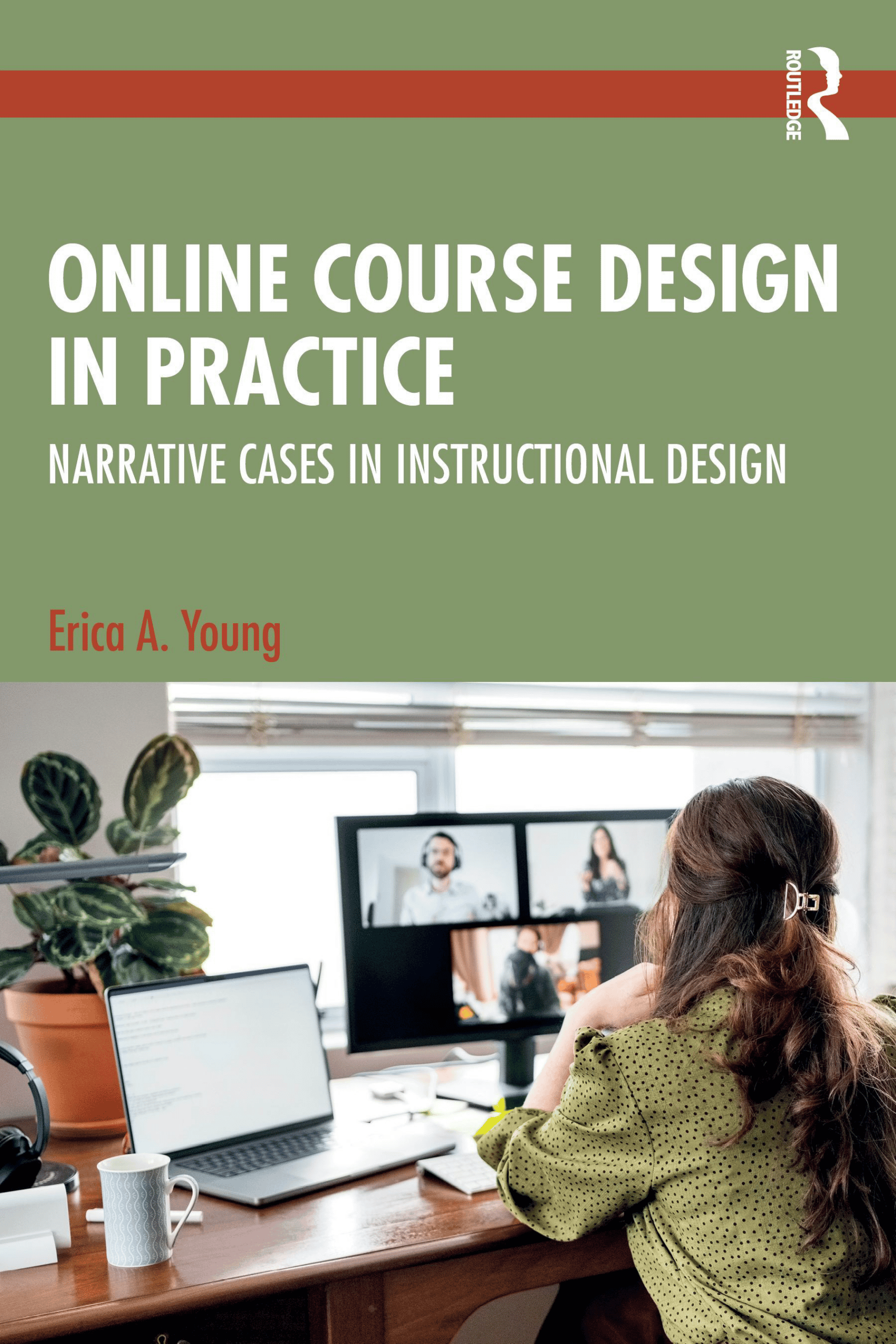
There is no shortage of books on instructional design. Most follow a familiar pattern: models, frameworks, process maps, checklists, templates and a somewhat sanitized account of how online learning is supposedly designed in practice. Erica Young’s Online Course Design in Practice: Narrative Cases in Instructional Design takes a very different approach, and that is precisely why it matters.
Rather than presenting instructional design as a linear technical exercise, Young presents it as a deeply human, relational, negotiated and contextual practice. Through narrative cases, she invites readers into the actual work of online course development: the tensions, ambiguities, compromises, institutional pressures, interpersonal dynamics and pedagogical judgments that shape design decisions.
In doing so, she captures something that’s often absent from other books: the lived reality of instructional design.
One of the strengths of this book is that it resists the temptation to portray instructional design as either purely technological or purely procedural. Instead, Young demonstrates how designers must navigate faculty expectations, organizational culture, competing timelines, resource constraints, accessibility concerns and learner needs at the same time. The cases illuminate the invisible labour of translation that instructional designers undertake every day: translating pedagogy into practice and creating learning experiences that are in line with the institution’s ambition.
The narrative structure is especially effective, featuring stories that demonstrate complexity in ways that abstract frameworks often can’t. Readers encounter precisely the conditions under which real design work occurs: uncertainty, conflict, adaptation and reflection. This makes the book particularly valuable for graduate students, novice instructional designers, educational developers and faculty members entering online learning environments for the first time. The cases create opportunities not simply for learning about instructional design, but for thinking like an instructional designer.
What also stands out is the timing of the book. Higher education is experiencing profound disruption due to generative AI, changing learner expectations, financial pressures and the normalization of hybrid and online learning. In this context, the role of the instructional designer is evolving rapidly. Designers are no longer merely support personnel helping faculty switch to online delivery. Increasingly, they are playing a bigger role in institutional transformation, learning architecture, assessment redesign and a more innovative student experience.
Young’s book quietly but effectively signals this shift. Importantly, the book also highlights a tension many institutions still fail to fully acknowledge: effective online learning design is not primarily a technical problem. It is an organizational and cultural challenge. The success of online learning often depends less on the platform or toolset than on trust, collaboration, communication and shared pedagogical purpose. The cases reveal how fragile and essential these relationships can be.
For readers interested in learning science, the book is a reminder that sound pedagogy rarely emerges from rigid adherence to models alone. Good design is iterative, responsive and adaptive. It requires judgment and empathy. And increasingly, in an AI-mediated educational environment, it requires careful thinking about what learning experiences remain deeply human.
This is perhaps where the book has its greatest value. At a time when instructional design risks being reduced to workflow automation, template production or AI-assisted content assembly, Young recentres the profession around making sense collaborating and educational intentionality.
If there is a limitation, it is perhaps that the book leaves the reader wanting even more engagement with the future trajectory of the field — particularly the implications of generative AI, cognitive offloading, adaptive learning systems and new forms of assessment. But this is less a criticism than an indication of how effectively the book opens the door to larger conversations about the future of teaching and learning.
Overall, Online Course Design in Practice is thoughtful, grounded and refreshingly authentic.
It treats instructional design not as a technical sequence, but as a professional practice shaped by human relationships, institutional realities and pedagogical judgment. In an age increasingly fascinated with automation, that is both timely and important.
A technically competent course is one that is well organized with clear expectations and due dates, is accessible to all members of the course and is easy to navigate with LMS functions working as intended. It must also have alignment. Alignment between course outcomes, weekly objectives, course materials and assessments is essential. Content must be intentionally chosen, and ideally the purpose should be communicated to learners.
A truly transformative course has all of those things while seeking to give the learners a very meaningful experience. What makes a course transformative is one that goes beyond content absorption and prompts application. When learning is truly transformative, the learner is able to apply what they are learning to their own lives. Plenty of relatable examples and opportunities to test new skills are given, and they are set on a learning adventure through hands-on activities. They become aware of how the course has stretched their existing mental schemas, requiring them to refine or extend prior understanding. These types of courses are engaging for learners, drawing them into the content as opposed to being passive recipients of it. Some design choices create these types of environments better than others.
When a learner has a transformative experience in a course, it is usually because the instructor provided them with meaningful, personalized feedback that both praises their successes and helps them identify areas for improvement. Although that is a teaching choice as opposed to a design choice, designers can help faculty create opportunities for feedback through strategic activities and formative assessments.
We use cookies on this site to enhance your user experience
By clicking "Accept" you agree to practices outlined in our Privacy Policy