
The biggest barrier is monopoly culture. This culture persists because of attitudes and structure. When supply-side block grants are tied to “natural” accreditation monopolies, institutions needing change feel no pressure to improve. Real reform seems like a loss of authority. LOLA does not just add another program to the system. It shifts the power to define, verify, fund and recognize learning. This makes the politics tough since everyone can support “lifelong learning” in theory but resist the changes needed to make it happen.
The approach is to use sequenced co-governance. Start by forming a coalition in high-need sectors where employers, learners and institutions recognize the deficiency of the current model. These areas face a talent shortage, weak credential signals and broken adult learning pathways. A shared governance group would include all members of the LOLA federation. Focus early work on solving shared problems rather than replacing institutions. Early successes should create new revenue streams for institutions along with new accountability requirements. When institutions see themselves expanding into open competency delivery rather than losing credential authority, they are less likely to oppose the changes.
It must start by passing legislation with a protected transition period. This is essential because no group alone will be the current beneficiary and end the block grant system or the accreditation monopoly. Setting a 10-year end date for institutional accreditation powers is important not as a threat but as a clear goal for institutions. The most important move is to make the risks of doing nothing clearer than the challenges of transition.
The current system creates a theatre of competition and innovation. The new model funds learners rather than institutions, shifts quality assurance to competency colleges and measures success by verified progress instead of time spent in seats.
Three main changes make this possible. First, portable learner accounts like the OpenFUND model would redirect the $2.4 billion that went to 26 post-secondary institutions, regardless of results, into individual learning accounts for all adult Albertans. Payments would go to whichever certified provider the learner chooses, turning learners from guaranteed revenue into customers whose business must be earned. Providers would then compete based on quality and relevance, not just on controlling credentials.
Second, giving employers equal incentives changes the usual employer-institution rivalry. A 50 percent workplace-learning tax credit for employers who become certified learning providers gives them a direct financial interest in the system, not just its results. Instead of complaining that institutions do not meet their needs, employers become part of the solution. The perverse dynamic where institutions both define standards and award credentials is broken. When a separate, sector-governed college owns the assessment protocol, providers compete on delivery quality rather than standard-setting authority. Hence, collaboration is embedded in open learning, but it is bottom-up, as it is the learner’s choice, not the institution’s.
The skills that deserve LOLA’s investment most are not those that compete with AI in speed, memory or pattern recognition. AI will keep outperforming people in those areas and many specific tasks. Instead, the focus should be on skills that help people decide what matters, why it matters, who is affected and what should be done. These abilities bring together context, ethics, trust, meaning and judgment in ways society cannot replace and that are hard to automate.
Three skill groups should receive the most attention.
The first is learning agility: the ability to learn, unlearn and relearn. More specifically, it is the ability to recognize skill depreciation, identify what is next and apply new knowledge in practice. In a fast-changing job market where AI accelerates skill depreciation, the most lasting human advantage is not any single skill but the ability to keep learning new ones. LOLA should see learning agility as the core skill that supports all others and keeps the system strong over a 50-year career.
The second is ethical decision-making in the face of uncertainty — the ability to use judgment in new situations where rules are unclear, values may conflict and mistakes affect real people. AI can only work within set rules; it cannot decide which rules matter when that is the main question. The humanities have always taught this skill, and the LOLA vision sees the liberal arts and sciences as the foundation of civic, professional and economic life. The difference is that these disciplines must also be bridged and contextualized for real-world application. This bridge to relevance is critical to the renewal cycle.
The third is relational judgment. This includes social and emotional intelligence that helps people build trust, read subtle signals, handle uncertainty in groups and take responsibility for outcomes in ways AI cannot. Leadership, conflict resolution, mentoring and managing teams in uncertain times are part of this. These are not just transferable skills; they make every other skill work in real life.
The most important indicators are not system metrics that only administrators see. There are changes in daily life that regular Albertans can notice.
First, Albertans would not be stuck with their last credential. A mid-career worker, a newcomer with foreign training, an older adult returning to work, or a young person without a degree could all demonstrate what they know and can do. Employers and learning providers across the province would recognize this. People would be recognized for skills they always had but could never “prove”. The jump from 200,000 registered learners to 3.7 million Albertans involved with LOLA would show this in numbers, but the real sign is how families talk about what education means.
Second, employers would hire and move people with real confidence, and everyone would notice. Instead of just looking at degrees or keywords on a résumé, employers would use trusted evidence of skills to find, develop, and move talent – including helping workers facing automation find new emerging roles. This model establishes an open and transparent labour and learning market. The market drivers will be open, and this will fuel both professional identities and learning pathways. This will be operationalized through the ‘learning equity clause’ in the Alberta Human Rights Act, and a shift away from credentials for hiring would be clear in who holds which jobs over the next decade.
Third, learning would be visible everywhere. Libraries, workplaces, colleges, community groups, employer training, and online providers would all be part of a single harmonized system, with a common credential that Albertans recognize and employers respect. People would not wonder if a learning experience counts – they would know how it counts, where it leads, and how it connects to their next step. By 2036, success would mean Albertans can prove their skills, employers trust that proof, and learning paths are available wherever people live, work, volunteer, or retrain.

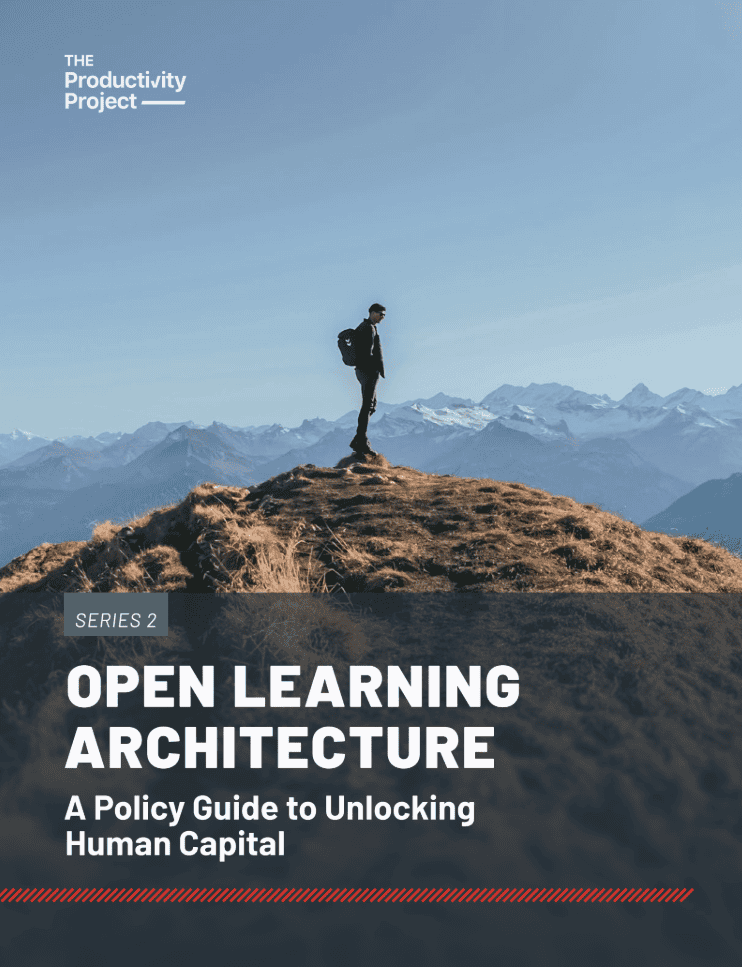
The 10 reports that comprise Series 2: Talent Reimagined represent one of the most ambitious attempts in Canada to rethink the relationship between learning, work, skills development, credentialing and economic prosperity. At their core is the proposal for a Lifelong Open Learning Architecture (LOLA), a framework intended to replace fragmented, institution-centred approaches to learning with a connected ecosystem capable of supporting individuals across 50-year careers.
The central argument is both compelling and timely. Canada’s existing learning architecture was designed for a world characterized by relatively stable occupations, linear career pathways and predictable transitions from education to employment. That world has disappeared. Technological disruption, demographic change, artificial intelligence, labour market volatility and the growing importance of lifelong learning have exposed weaknesses in systems built around front-loaded education and episodic retraining. The reports argue that the challenge facing Alberta is not simply one of skills shortages but of systemic design. The existing infrastructure for developing, recognizing and deploying human capability is no longer fit for purpose.
One of the greatest strengths of the series is that it refuses to treat learning as an educational issue alone. Instead, learning is framed as a social, economic and civic infrastructure challenge. This perspective echoes earlier LearningCITY work, which emphasized the need for an open learning system, purpose-based learning, experiential learning and the development of enabling competencies. The reports recognize that talent development is not owned by schools, colleges, universities or employers individually. Rather, it emerges from interactions among learners, learning providers, employers, credentialing organizations, governments and communities. This systems perspective distinguishes the work from many conventional workforce development reports.
The LOLA framework itself is a noteworthy contribution. Rather than proposing another isolated program or policy intervention, the framework seeks to create connective tissue between existing actors. The vision is one in which competencies can be recognized regardless of where they are acquired, individuals have greater agency in managing their development, employers gain better visibility into capabilities and policymakers possess richer intelligence regarding talent flows and needs. The ambition is considerable, and the reports deserve credit for attempting to move beyond incremental reform toward systemic redesign.
Another strength lies in the practical orientation of the work. Many policy papers diagnose problems without offering credible pathways forward. Series 2 instead presents a 10-year transition roadmap. Although some recommendations will undoubtedly prove difficult to implement, the effort to move from aspiration to architecture is refreshing. The reports recognize that transformation requires infrastructure — digital, financial, regulatory and social — not merely goodwill.
The series is also notable for its optimism. At a time when much public discourse surrounding AI and labour markets focuses on displacement and decline, these reports adopt a more constructive stance. Human capital is treated not simply as a resource to be managed but as the primary determinant of future prosperity. The emphasis on learner agency, recognition of diverse pathways and lifelong adaptability provides an alternative to narratives that portray individuals as passive victims of technological change.
Yet the work also raises important questions. The first concerns governance. The reports are persuasive in identifying the need for system-level coordination, but less clear regarding who ultimately owns and governs such a system. Canada’s education and training landscape is notoriously fragmented. Postsecondary institutions protect autonomy, professional regulators guard standards, employers vary widely in their approaches to talent development and governments often operate within short political cycles. The challenge is not simply technical integration but institutional alignment. The reports acknowledge the need for collaboration but perhaps underestimate the political economy of change.
A second challenge concerns incentives. Much of the framework depends upon organizations acting in collective rather than purely institutional interests. Yet educational institutions are funded according to their own enrolments, employers often prioritize short-term hiring needs over long-term talent development and individuals frequently make learning decisions based on immediate economic pressures. The reports would have benefited from a deeper exploration of how incentives could be redesigned to support the behaviours LOLA requires.
Third, while the series appropriately emphasizes competencies and capability development, it occasionally risks understating the enduring importance of disciplinary knowledge and professional expertise. Adaptability matters enormously, but so does deep expertise. The future likely requires both. A stronger articulation of how evergreen capabilities interact with domain-specific knowledge would strengthen the overall framework.
Finally, there is the question of scale. Alberta provides a useful testbed for experimentation, but many of the issues identified are national and even global in scope. Readers may wonder whether LOLA is primarily a provincial policy framework, a national model or a prototype for broader international adoption. Greater discussion of transferability would enhance the work’s influence.
Despite these critiques, Series 2: Talent Reimagined is an important contribution to contemporary discussions about the future of learning and work, especially when taken together with Series 1 – Productivity & People and Series 3 – The End of Entry-Level Jobs with more to come in a new Series 4 – Evergreen Capabilities. It is rare to encounter policy work that combines systems thinking, practical ambition and a willingness to challenge long-established assumptions. Whether one agrees with every recommendation is almost beside the point. The reports succeed in reframing the conversation from “How do we improve education?” to the more consequential question: “How do we build a society capable of continuous learning and adaptation?” That shift alone makes the series worthy of serious attention.
In an era when many jurisdictions are struggling to connect education, workforce development, and economic strategy, Talent Reimagined offers a provocative and hopeful vision. It is not a finished blueprint. It is an invitation to a much larger conversation about how talent is developed, recognized and sustained in the decades ahead.
The most important indicators are not system metrics that only administrators see. There are changes in daily life that regular Albertans can notice.
First, Albertans would not be stuck with their last credential. A mid-career worker, a newcomer with foreign training, an older adult returning to work, or a young person without a degree could all demonstrate what they know and can do. Employers and learning providers across the province would recognize this. People would be recognized for skills they always had but could never “prove”. The jump from 200,000 registered learners to 3.7 million Albertans involved with LOLA would show this in numbers, but the real sign is how families talk about what education means.
Second, employers would hire and move people with real confidence, and everyone would notice. Instead of just looking at degrees or keywords on a résumé, employers would use trusted evidence of skills to find, develop, and move talent – including helping workers facing automation find new emerging roles. This model establishes an open and transparent labour and learning market. The market drivers will be open, and this will fuel both professional identities and learning pathways. This will be operationalized through the ‘learning equity clause’ in the Alberta Human Rights Act, and a shift away from credentials for hiring would be clear in who holds which jobs over the next decade.
Third, learning would be visible everywhere. Libraries, workplaces, colleges, community groups, employer training, and online providers would all be part of a single harmonized system, with a common credential that Albertans recognize and employers respect. People would not wonder if a learning experience counts – they would know how it counts, where it leads, and how it connects to their next step. By 2036, success would mean Albertans can prove their skills, employers trust that proof, and learning paths are available wherever people live, work, volunteer, or retrain.
We use cookies on this site to enhance your user experience
By clicking "Accept" you agree to practices outlined in our Privacy Policy