
For a personal AI partner to strengthen humanagency, three things must go right. First, the AI must be aligned with the individual learner, not with the incentives of a platform, advertiser or institution. Second, it must be transparent and contestable, so people can understand how it reasons and can challenge or override it. Third, it must be self-sovereign, meaning the individual controls their data, their model and the terms of engagement.
The earliest warning sign that agency is being undermined is when the AI begins to narrow choices instead of expanding them. If it quietly nudges behaviour in ways that serve someone else’s interests, substitutes convenience for judgment or makes decisions on your behalf without meaningful consent, then power is shifting away from the human. A true personal AI should amplify reflection, curiosity and autonomy, not replace them.
The core argument still stands because the usefulness of AI is not about hype cycles. It is about human agency in a world increasingly mediated by intelligent systems. Whether AI advances quickly or more slowly, it will shape how we work, learn, manage our health and participate in civic life. The fundamental question of who controls these systems and for whose benefit does not go away.
What may need rethinking is the pace and architecture of adoption. If regulation slows large, centralized platforms, we may see more decentralized, domain-specific or personal AI systems emerge. That would actually strengthen the case for self-sovereign, user controlled AI. The real danger is not regulation
itself, but regulatory capture that entrenches institutional power instead of protecting individuals.
Much of the current conversation about AI risk focuses on hallucinations, bias, faulty recommendations and fears that machine intelligence may one day exceed human intelligence. These concerns are real, but they may not be the most profound challenge ahead.
A deeper issue is emerging. If each of us comes to rely on a digital doppelganger — an AI that extends our memory, judgment, creativity and decision making — who will own that intelligence? Today, our data patterns and preferences are effectively controlled, or at least rented by, a small number of powerful technology platforms. In the Identic era, this arrangement becomes dangerous.
When your most valuable asset is your extended intelligence, losing authority over it means losing control over your life. This affects your economic choices, your beliefs and, ultimately, your agency as a human being.
Consider something as simple as product placement. In the past, companies paid to place a soda or a car in a movie, hoping the image would influence attention and desire. Now imagine that same power applied not to what you watch, but to the system that helps you think. Instead of placing a product on a screen, an advertiser or a political actor could insert a suggestion, a priority or even a worldview directly into the AI you rely on to reason, learn and make decisions. That is not marketing. It is cognitive capture.
This is why self-sovereign Identic AI is essential. Your personal AI — not just your data and your history but your values and cognitive extension — must be owned and controlled by you, not by corporations whose incentives lie elsewhere. Nor should governments own or control it except under narrow, transparent conditions of due process and clear harm. Control over one’s AI should be treated not as a software setting, but as a fundamental human right.


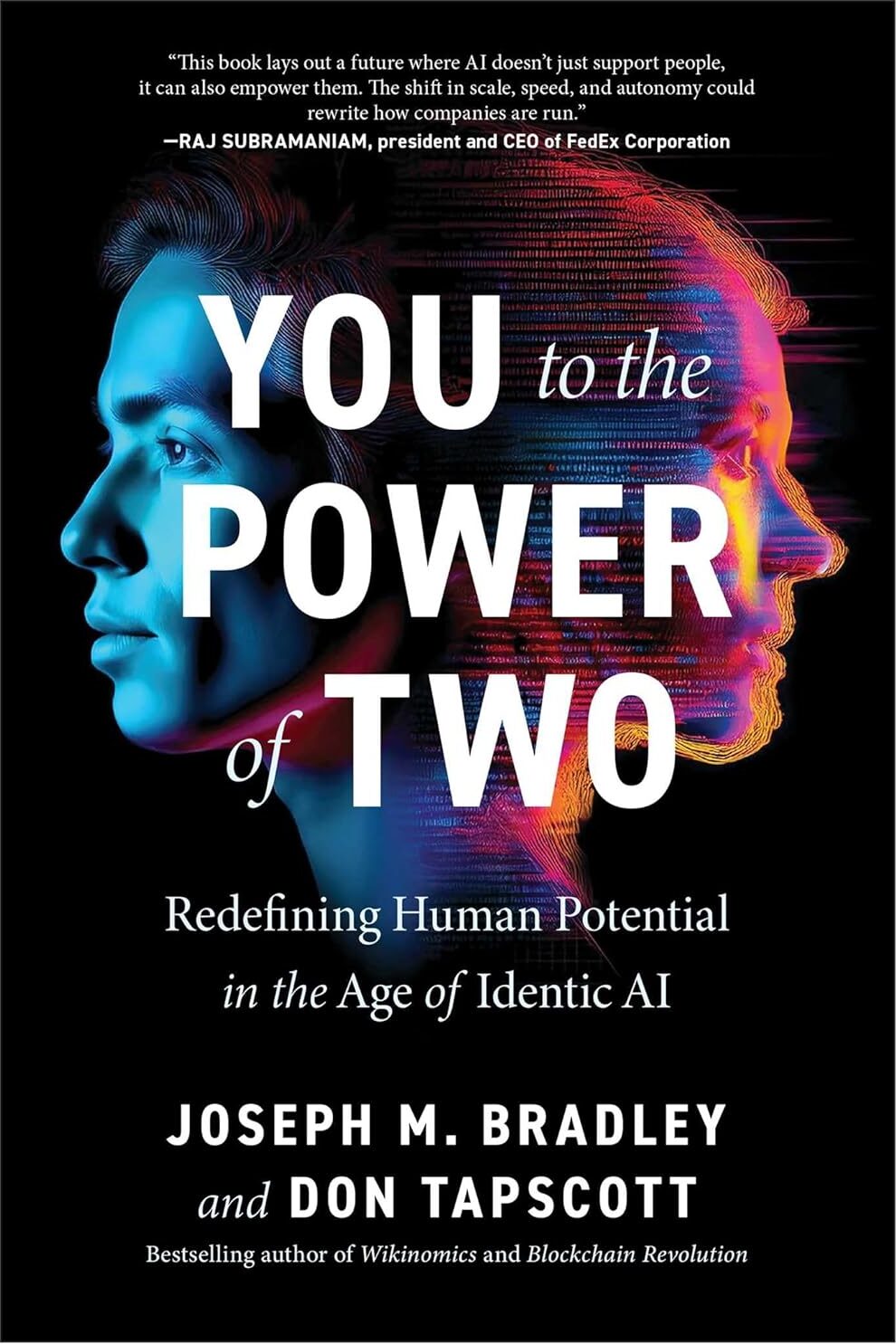
Joseph Bradley and Don Tapscott’s book, You to the Power of Two, arrives at a pivotal
juncture in both technological evolution and societal self-reflection. Tapscott, long
recognized as a leading voice on the economic and social impacts of transformative
technologies, has built a prolific career examining how digital infrastructures reshape
human systems, from markets and organizations to individual identity and community
life. His new collaboration with human-centered strategist Joseph Bradley extends this
tradition into the emergent territory of “Identic AI,” offering an ambitious conceptual and
practical framework for understanding how personalized AI can expand human potential
while reframing core questions of agency, autonomy and identity.
At its core, You to the Power of Two argues that we are entering a new era in which
AI no longer functions merely as an external tool but becomes a deeply integrated,
co-creative and intelligent partner in human life. The authors coin the term “Identic
AI” to describe highly personalized AI agents that serve not just as assistants but as
extensions of our cognitive, emotional and social capacities — functioning, in effect, as
digital “second selves” that amplify what humans can do in every dimension of life. This
conceptual leap is the centerpiece of the book’s thesis: that the promise of AI lies not in
replacing human effort but in augmenting human identity itself.
The strength of You to the Power of Two lies in its wide-angle perspective, which
situates emerging AI within a broader historical arc of technological adaptation.
Tapscott’s earlier work, from Wikinomics to Blockchain Revolution, has charted
successive waves of digital transformation, examining how networked collaboration,
decentralization and new forms of value creation redefine markets and institutions.
Here, that lineage continues by positioning Identic AI as the next evolutionary stage
in that trajectory: a shift from “connected technology” to “internalized intelligence.”
Although earlier frameworks emphasize collective enablement through networks, this
book posits that the most consequential frontier will be the individualized interface
between human and machine.
What makes the book particularly compelling is its balance of vision and grounded
analysis. The narrative is rich with scenarios that illustrate how Identic AI might manifest
across domains such as work, education, health, governance and interpersonal
relationships. For example, the authors explore how tailored AI partners could support
lifelong learning by continually adapting to a learner’s evolving needs, or how in the
workplace such agents might manage complexity and cognitive load, freeing humans
to focus on creativity and judgment. Equally, the book does not shy away from potential
hazards, including privacy infringement, deepening inequality and the erosion of
personal agency if such systems are captured by commercial or state actors.
The book’s philosophical grounding provides another notable dimension. Bradley and
Tapscott repeatedly emphasize that human values must remain the compass guiding
technological design and deployment. They propose that Identic AI should be framed
not as a mechanism for efficiency alone, but as a vehicle for enhancing dignity, self-determination
and relational depth. This emphasis on ethical orientation is timely; as public debate about
AI governance intensifies, You to the Power of Two contributes a human-centered narrative
that counters reductionist techno-optimism or fear-driven dystopian alike. It insists that without
intentional cultivation of what the authors term “artificial wisdom,” society risks amplifying bias,
fragmentation and power imbalances rather than human flourishing.
Nevertheless, the book is not without limitations. At times, its sweeping futurism leans
heavily on broad speculation, and some readers may find that the conceptual leaps
toward fully integrated personal AI companions outpace the current state of technology
and regulation. There is also an implicit assumption that the trajectory toward Identic
AI is both inevitable, unstoppable and desirable — a claim that, although well-argued,
might benefit from deeper engagement with counterarguments rooted in critical social
theory or political economy. The authors also ignore the coming tech-bubble burst,
which many economists and market watchers now predict. Additionally, the wide range
of domains addressed means that some chapters trade analytical depth for breadth,
with the treatment of complex governance and equity challenges sometimes skimming
rather than interrogating underlying institutional obstacles.
Overall, You to the Power of Two is a provocative and insightful contribution to AI
literature. Its central thesis —that the future will be defined not by human versus
machine, but by human plus machine — offers a refreshing and humanistic lens on
technological change and builds on earlier work, notably that by Ethan Mollick. Bradley
and Tapscott articulate a future in which individuals and communities can harness
AI not merely to enhance productivity, but to expand what it means to be human. For
policymakers, organizational leaders, educators and thoughtful citizens wrestling with
AI’s implications, this book serves as both a roadmap and a call to intentional action.
We use cookies on this site to enhance your user experience
By clicking "Accept" you agree to practices outlined in our Privacy Policy