
I would argue that the challenge of genAI is both technological and pedagogical; nonetheless, the focus of the book is on how we (as society, but also as instructors) can manage this new technology that poses a paradigm shift in education at all levels. In one sense, I’m not sure that any assumptions about teaching and learning had to change due to genAI since educators are always dealing with new technologies and theories about pedagogy. In another sense, genAI may be the most radical of new technologies because of its potential. There are some people (e.g., politicians) who seem to think that teaching can be done by computers and robots using AI. If you look at the history of educational technologies, when radios, videos and personal computers first arrived, for example, they were also seen as cost-saving measures and potential replacements for teachers in the classroom. Yet, this did not happen. The challenge is that genAI is a technology that tempts people (instructors, students, workers, etc.) to look for easier ways to do hard or time-consuming things, like writing and thinking. The chapters in the book illustrate some of the ways that university instructors are navigating the ethical use of the technology while also paying attention to academic integrity and ensuring students are not offloading their thinking and learning to this shiny new tool. The chapters are largely about how instructors are rethinking their approaches to teaching in light of the new AI agents.
Surveillance and policing have never been particularly good at preventing plagiarism, even before the advent of genAI. Things like text-matching software can help instructors to identify potential problems, but the results always need to be interpreted. To date, the new AI-detection software has been very unreliable. This means that institutions need to begin by offering improved faculty development to help instructors better understand AI while bearing in mind that it can increase instructor workload. For instructors to be able to incorporate any use of genAI and to redesign their courses, they need to have a good understanding of how it works; learning a new technology and redesigning courses and assessments are both very time-consuming. To move beyond a reliance solely on the individual capacity of instructors, both curriculum and
assessments need to be re-evaluated and redesigned at a high level, not to avoid or prevent the use of genAI, but rather to ensure students are learning and understanding the curriculum in a fulsome way, whether or not the technology is used. Developing useful institutional policies around the use of specific technologies that have become so pervasive so quickly is challenging. I think any policy would need to be open enough to be useful and adaptable for different disciplines and evolving technologies; at the same time, it would need to provide necessary guardrails to protect research integrity and ensure learning still occurs. This task is proving to be particularly challenging.
I don’t think there was significant disagreement amongst the authors because our underlying research focus is on strategies to prevent plagiarism. There are some nuances in how each author would use genAI; indeed, while some are more willing than others to embrace the technology, we each approach its use with caution and awareness of the pitfalls an overreliance on such a new technology would bring, especially when there is much uncertainty around its long-term sustainability, costs, and equity.
I hope readers will take away an understanding of the complexity of using genAI as an educational technology. Today, we are very much in the infancy of publicly accessible genAI tools, and I believe we need to bear in mind that all technologies come with pros and cons. While genAI has much potential to make some things easier to do, will an overreliance on it diminish humans’ capacities for thinking and problem-solving? This may be silly, but as a fan of apocalyptic sci-fi, in the back of my mind I wonder what will happen if AI become even more pervasive: if the worst happens and these technologies collapse after we have come to rely on them, will we humans remember how to cope without the support of AI? Will we still have access to information and knowledge? I believe we need to hope for the best and plan for the worst. In education, I think we do this by ensuring that students learn critical and complex thinking skills alongside their disciplinary and technological skills.

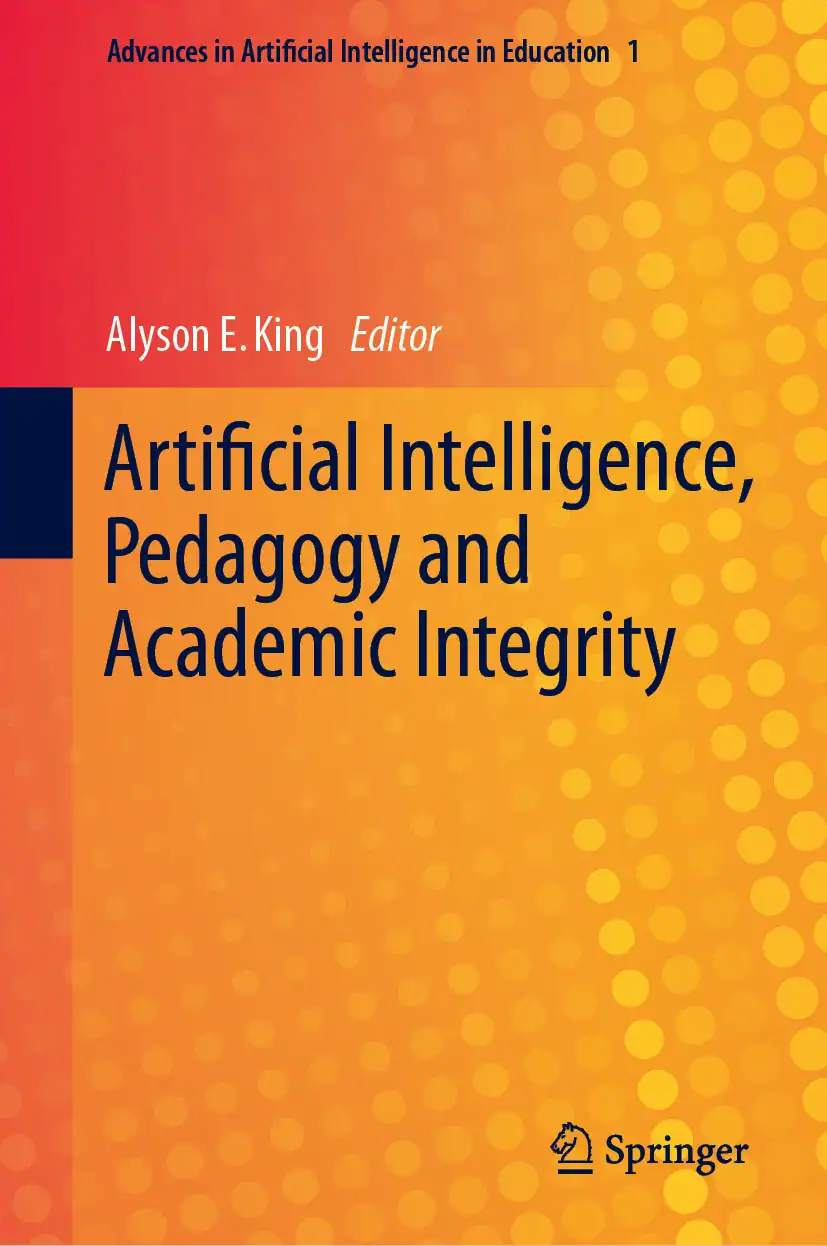
Artificial intelligence has generated no shortage of books warning educators about plagiarism, cheating and the collapse of assessment. What distinguishes Alyson King’s edited volume is that it refuses to treat generative AI simply as a threat. Instead, it asks a more useful question: How should pedagogy change now that AI exists? That shift in emphasis makes this one of the more worthwhile contributions to the growing literature on AI in higher education.
The collection brings together contributors from Canada, the United Kingdom, Croatia, Ukraine and the United States, offering a welcome diversity of institutional and cultural perspectives. The chapters address AI policy, assessment design, academic writing, academic integrity, copyright and the implications of large language models for teaching and learning.
Rather than advocating for blanket prohibition or uncritical adoption, the contributors argue that universities must redesign learning environments so that students learn to use AI responsibly while continuing to develop critical thinking, writing and scholarly judgement.
One of the book’s principal strengths is its practical orientation. Readers will find discussions of institutional policies, examples of course redesign and strategies to create authentic assessments that reduce opportunities for inappropriate AI use. Particularly valuable is the recognition that integrity is not primarily a technological problem but an educational one. Better assessment, clearer expectations and explicit instruction in ethical AI use are presented as more sustainable responses than reliance on increasingly unreliable AI-detection software.
Equally refreshing is the book’s attention to questions of equity and access. Several chapters acknowledge that generative AI may lower barriers for multilingual learners, non-traditional students and those requiring additional academic support. Rather than framing AI solely as an instrument of misconduct, the contributors recognize its potential as a legitimate learning partner when used transparently and ethically. This broader perspective moves the discussion beyond simplistic narratives of “cheating” toward the more challenging task of rethinking university teaching itself.
The collection is not without limitations. At just 168 pages, some chapters necessarily provide introductory treatments rather than deep empirical or use-case analyses. Readers seeking extensive longitudinal evidence on learning outcomes or institutional implementation will need to look elsewhere. The volume also concentrates largely on higher education, leaving questions about schools, workplace learning and professional education relatively unexplored.
Nevertheless, the timing of the book is excellent. While many institutions continue debating whether AI should be permitted, this volume assumes the more realistic position that generative AI is now part of the educational landscape and asks how educators should respond. Its central message — that academic integrity depends as much on thoughtful pedagogy as on effective regulation — is persuasive and timely.
For university teachers, educational developers, academic integrity officers and institutional leaders grappling with AI policy, this is a concise, practical and thought-provoking collection. It succeeds not because it offers definitive answers but because it reframes the conversation from detecting misconduct to designing learning that remains meaningful in an age of intelligent machines. That is likely to prove the more enduring contribution.
I don’t think there was significant disagreement amongst the authors because our underlying research focus is on strategies to prevent plagiarism. There are some nuances in how each author would use genAI; indeed, while some are more willing than others to embrace the technology, we each approach its use with caution and awareness of the pitfalls an overreliance on such a new technology would bring, especially when there is much uncertainty around its long-term sustainability, costs, and equity.
I hope readers will take away an understanding of the complexity of using genAI as an educational technology. Today, we are very much in the infancy of publicly accessible genAI tools, and I believe we need to bear in mind that all technologies come with pros and cons. While genAI has much potential to make some things easier to do, will an overreliance on it diminish humans’ capacities for thinking and problem-solving? This may be silly, but as a fan of apocalyptic sci-fi, in the back of my mind I wonder what will happen if AI become even more pervasive: if the worst happens and these technologies collapse after we have come to rely on them, will we humans remember how to cope without the support of AI? Will we still have access to information and knowledge? I believe we need to hope for the best and plan for the worst. In education, I think we do this by ensuring that students learn critical and complex thinking skills alongside their disciplinary and technological skills.
We use cookies on this site to enhance your user experience
By clicking "Accept" you agree to practices outlined in our Privacy Policy